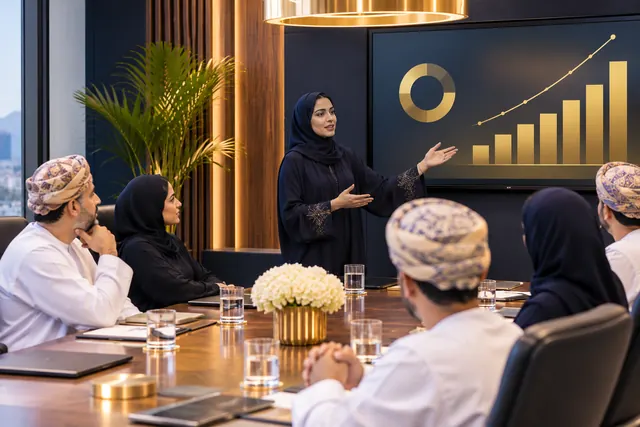

Women hold 51 of the 731 board seats tracked in Oman by the GCC Board Gender Index 2026, which Heriot-Watt University and Aurora50 published in April 2026. That puts Oman at 7.0 percent, level with the GCC average of 7 percent. The same report shows the region moving forward slowly, from 6.9 percent a year earlier.
A figure like this tells a nominations committee something concrete. When a board fills a seat, its members usually look at people they already know: former chief executives, fellow directors, senior partners in familiar firms. If few women move in those circles, few women reach the shortlist. The gap opens in the pipeline years before it shows in the boardroom.
Board composition is a governance question
Directors owe duties to the company and its shareholders. To meet those duties, a board needs people who test management's assumptions, read risk from different angles and ask the question nobody else in the room has asked. A board drawn from one professional background tends to share one set of blind spots. Directors with different careers, sectors and experiences give the chair more ways to challenge a plan before the company commits money to it.
Investors and lenders watch board composition too. International funds ask Gulf companies about independence, skills and diversity as part of their due diligence. A board that answers those questions with confidence has an easier conversation with the capital it wants to attract.
The rules around Omani boards are changing
The rules that shape Omani boards have moved quickly in the past two years. In March 2024, Royal Decree 20/2024 established the Financial Services Authority, which took over from the Capital Market Authority as the regulator of the capital market and the insurance sector.
For closed joint stock companies, Ministerial Decision 5/2025 from the Ministry of Commerce, Industry and Investment Promotion introduced governance requirements that took effect in January 2025. At least one third of board members must be non-executive, the chair and the chief executive must be different people, and larger companies need independent directors. The decision also expects directors to bring qualifications and experience that suit the company's activity.
In 2026 the Financial Services Authority adopted the IFRS S1 and S2 sustainability disclosure standards for listed companies and financial institutions, with full application from 1 January 2029. Boards will need directors who understand climate risk and sustainability reporting. Each change raises the bar for what a director must know, and each one widens the set of skills a nominations committee should look for.
What makes a director board-ready
Seniority alone does not prepare someone for a board seat. An accomplished general manager may run a large operation and still find the boardroom unfamiliar, because the role asks for different habits.
Fiduciary understanding
A board-ready director knows the duties of care and loyalty, recognizes a conflict of interest and declares it on time. She can explain where oversight ends and management begins, and she keeps to her side of that line.
Financial fluency
She reads a balance sheet, a cash flow statement and an auditor's report with ease. She notices the early signs of trouble: revenue that grows while cash shrinks, provisions that move without explanation, related-party transactions that deserve a closer look.
Committee experience
Much of a board's real work happens in its audit, risk, and nominations and remuneration committees. A director who has sat on a committee, even as an observer, arrives at her first full board meeting knowing how papers flow and how decisions get made.
Judgment under pressure
Boards earn their keep in difficult moments: a failed acquisition, a regulator's inquiry, a chief executive who needs replacing. A board-ready director stays calm, asks precise questions and holds her position when the evidence supports it.
How companies can widen the pipeline
Organizations that want more women on their boards can start long before a seat falls vacant.
- Use subsidiary boards as a training ground. Groups with several companies can appoint senior women to subsidiary and affiliate boards, where they build real governance experience with lower stakes.
- Open committee observer roles. A high-potential executive who observes an audit or risk committee for a year learns how oversight works in practice.
- Pair candidates with sitting chairs. A chair who mentors one candidate a year passes on the unwritten rules: how to prepare, when to speak, how to disagree without damaging trust.
- Publish a board skills matrix. A matrix that lists the skills the board needs widens the search and makes it fairer, because it rewards capability over familiarity.
- Fund structured preparation. Sponsoring a director development program shows that the company treats board readiness as an investment in its own governance.
Sovereign-linked groups and listed companies in Oman can lead this work. Their boards are visible, their appointments shape expectations across the market, and their subsidiaries offer many seats where new directors can learn.
What nominations committees can change
The nominations committee holds the most direct lever. A committee that opens each search with the board's skills matrix, instead of a list of familiar names, asks a better question: which capability is missing, and where might the board find it?
Committees can also widen the places they look. Senior women lead large functions in banking, energy, logistics, law and government without ever appearing on a board shortlist. Professional associations, partner firms and the alumni of leadership programs can surface candidates that a chair's personal network would miss.
The process deserves attention too. Clear criteria, a written description for each seat and interviews conducted by more than one director reduce the pull toward people who resemble the current board. They also make each appointment easier to explain to shareholders at the general meeting.
Finally, committees can plan ahead. A board that knows which directors will rotate off in the next three years can build relationships with candidates now: invite them to brief a committee, involve them in a strategy day, or appoint them first to a subsidiary board. Seats filled in a hurry go to the familiar. Seats planned in advance give new talent a fair chance.
From representation to influence
The real target sits beyond a higher percentage in next year's index. A woman who joins a board should arrive ready to shape its decisions: to question a budget, to lead a committee and, in time, to chair the board itself. That takes preparation, sponsorship from senior leaders, and companies willing to give capable candidates their first seat.
Oman Vision 2040 places people and their capabilities at the center of national development. Boardrooms are one of the places where that commitment becomes visible, one appointment at a time.
The National Academy of Leadership and Innovation designed its Women on Boards program around these skills. It combines governance, financial oversight and boardroom simulation for senior women preparing for a first or a next board role.